
2007 US Prospective Plantings
- Tuesday April 17, 2007
This analysis featured in the April 17, 2007 issue of the HGCA's MI Prospects, Volume 9, Issue 20
Key points
- 15% increase in prospective maize plantings, well above most expectations
- Higher maize area at the expense of soyabeans and to a lesser degree spring wheat and cotton
- Maize area seen at 36.6Mha, soyabean area at 27.2Mha and winter wheat area at 18.0Mha
- Late spring may prevent farmers from planting all the area to maize as intended
The 15% increase in prospective planting of maize in the US exceeded most expectations. The increase in area came mainly at the expense of soyabeans and to a lesser degree spring wheat and cotton. Total area sown to maize and wheat may suggest some movement of area out of conservation. Price implications may not be as negative as originally anticipated.
Background - Of all the annual USDA crop reports the Prospective Plantings report is perhaps the most significant. In early March the USDA surveys about 86,000 farmers on their spring planting plans. Farmers, particularly in the major Midwest maize producing states have considerable, but not unlimited, flexibility in crop selection between maize and soyabeans, the two most significant spring sown crops.
While farmers can change their plans over the two months or so between the survey and the conclusion of sowing, the report has traditionally provided a good indication of actual plantings particularly if the results are factored to take account to significant developments like delays in sowing or major changes in market prospects. Last year there were no such developments and so prospective plantings reflected what was actually sown (Table1).
This year the interest in the report has been intense because of very diverse market fundamentals for maize, for which the supply situation is, and is expected to continue to remain tight, and soyabeans for which supplies are relatively abundant. Over the last few months there have been a succession of forecasts of the results of the Prospective Plantings Survey and / or actual plantings for theses two crops. The basis for these projections were varied, but significantly none involved the breath or depth of the USDA report. It is this that gives the USDA Prospective Plantings report such a high profile.
Results - The report indicated that US farmers planned, as of early March, to plant 36.6Mha of maize, 15% more than they planned at this time last year and eventually ended up sowing last year (Table 1). This would be the largest US maize area since the Second World War. An increase was almost universally anticipated but the USDA figure was almost 1.0Mha above the average of the trade expectations and higher than all but one forecast. This increase in maize area comes mainly at the expense of soyabeans, cotton and spring wheat. Further, total 2007 prospective area of major crops was 1.6Mha higher than last year, suggesting some net-movement of area out of conservation programmes.
continue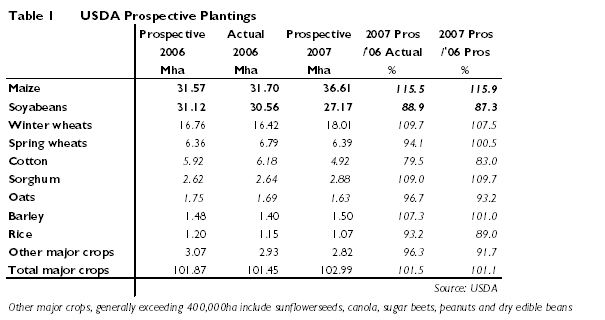 continued
The prospective soyabean area is 11%, or 4.0Mha, at 27.2Mha, with lower areas generally planned throughout the Midwest. Cotton area is 20%, or 1.3Mha, lower at 4.9Mha. It seems that it is planned to put the bulk of the reduced area into maize, although some has already been sown to winter wheat. The spring wheat area is 6%, or 0.4Mha lower at 6.39Mha, with area seemingly being switched disproportionately to maize in South Dakota, but to winter wheat elsewhere.
Cotton is a high value crop, probably with a similar economic status to potatoes or sugar beet in UK arable rotations. Therefore a substitution of maize area would not have been expected but for relatively unfavourable prospects for cotton in combination with favourable prospects for maize.
The 10% increase in winter wheat area to 18.0Mha reflects the more favourable market prospects for wheat at planting in late 2006, also favourable moisture conditions at that time, and the reality that over much of the Great Plains wheat is really the only cropping option. Much of the increase in area will be hard red winter wheat evident in almost all Great Plains states, although in the southern Delta states the area of soft red winter wheat was increased at the expense of cotton.
Area sown to sorghum, a feed grain, suited to more marginal moisture situations was up 9% to 2.9Mha. Barley grown mainly in the northern states was also up 9% but malting demand is probably more of a factor than feed with this crop. The prospective area of oats, which is grown very widely, typically for local markets, is 3% lower even though oats prices have been quite as strong as those for maize.
Implications - With the prospective 15% increase in maize area and last year’s yields would result, after allowing for a 62% reduction in beginning stocks, in a 3% increase in US maize supplies (Table 2). While consumption of US maize is projected to increase again this year, there may have been some immediate doubt in the market over a further increase of this magnitude given prices at 10-year highs. The market, therefore, initially reacted very negatively to the report with prices declining the daily trading limit of US$0.20 /bu (US$7.90 /t) for two trading days after the report.
continue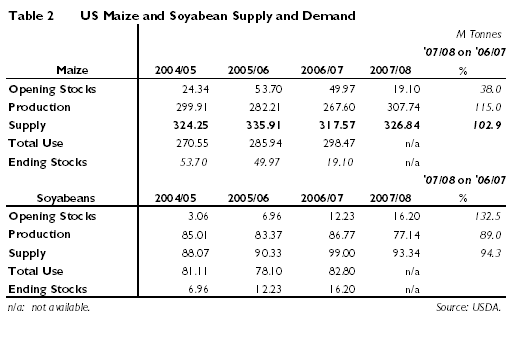 continued
Furthermore wheat prices also declined immediately following the report, while soyabean prices did not benefit from the prospect of a generally larger than expected cut in soyabean area and a tighter supply situation. For several months, however, soyabean prices have been shadowing maize prices on the supposition that price relationship between the two crops needed to be kept in balance to avoid too large a swing out of soyabean production.
Assuming last year’s soyabean yield and a 11% reduction in area would result in the same percentage decline in output. Total soyabean supplies after factoring the 32% increase in beginning stocks would fall by 6%, but to a level 13% above the projected use. The implication of this scenario is that ending stocks would decline from this year’s record level but not to a level that would be disruptive of long-term prospects.
By the end of the week following the report markets prices appeared to be heading back to where they were before the report. This probably indicates a consensus that the report, although not as expected, was not very damaging to price prospects. What is evident is that while ethanol fuel demand is specific to maize, it is having an impact on all major crop commodity markets and this will likely spread to other agricultural markets. Ethanol fuel use consumed maize from the equivalent of 5.8Mha this year. An expanding area continues to be needed to feed this demand.
Beyond the impact price developments, two issues are emerging that also may be critical to farmers making that final decision as to what to plant. A shortage of nitrogenous fertilizers could develop, that would favour the sowing of legumous soyabeans in the minds of most farmers (see pages 6 and 7).The second is the mounting concern over the impacts of what increasingly appears to be a late spring. This may limit what farmers are able to get in the ground before the yield penalty for late maize planting starts to favour shorter season soyabeans.
David Walker 001 780 434 7615
top of page